What is this album about?
The different stages, perspectives, and circumstances that a person can be loved.
Not one relationship, but the many ways love shows up. Love that trembles. Love that transforms. Love you hold onto through objects. Love that burns. Love that knows its limits. And love in its simplest form: wanting to hold someone.
Nine songs across multiple cities and five years. Arranged not chronologically, but emotionally, from chaos to home.
Are the city timestamps real?
Sort of.
They have direct or indirect connections to where the notes, lyrics, and reflections were written. Barcelona at 0:01 am. Lisbon at 0:12 am. Berlin at 1:21 am. Some are literal, I was there, at that hour, writing those words. Others are more of an emotional marker than a geographic one.
The exact relationship between city and song is intentionally left open. I think that's part of what makes music work, you bring your own cities, your own late nights, your own memories to it.
Like any artistic project, I put emotions into something, and when you consume what I made, you might experience them shaped by completely different circumstances. That's not a flaw. That's the beautiful part. We don't have to feel a song the same exact way to still connect through emotion.
Why does the album start with "Barcelona" and end with "The stupid need to hug you"?
"Barcelona 0:01 am" opens with everything falling apart. The room shaking, searching for someone who isn't there, everything crumbling. But the song doesn't stay there, it ends with the line: "Maybe that's the beauty of it, because it's real. Because in the end, it's shared."
That's the thesis of the whole album, right there in the first track.
From there, the album moves through different shades of love, longing in Lisbon, reimagined love in Berlin, grief in Prague, passion that makes everyone angry, tenderness that knows its limits in Paris. Until reaching "Still breathing (still dreaming)" which aims to explain why I make music at all: not because I'm good at it, but because I need to.
And then it closes with the simplest possible thing. After all the complexity, all the cities, all the questions that don't have answers, it ends with wanting to hold someone. That felt like the only honest way to finish.
Did you use AI to make this?
Yes. AI tools were part of the production.
I work professionally in AI, specifically at the intersection of life sciences and language models. But this project is something different. It's a side exploration into how this technology is evolving in less rational, more human spaces. A way to tackle some of the questions I keep asking myself about life, meaning, and connection, and to see how AI can meet my songwriting, which has been part of me since I was 18.
The songs are mine. Five years of writing about love and loss and cities where it all happened. AI helped me reach sounds I couldn't reach alone. The technology became part of the conversation.
But here's what I keep coming back to: if you felt something while listening, that feeling was entirely yours. No algorithm gave you that.
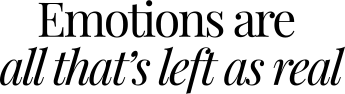
What do you mean by "emotions are all that's left as real"?
We're reaching a point where all our interactions with the external world are getting blurred. The line between what's real and what's not, it's not blurring anymore. From my perspective it has already been crossed. The media we consume might be AI-generated. How we reply to it might be too. The photos, the voices, the conversations, any of it could be synthetic now.
So what's still left that we can trust?
I keep coming back to emotions. How we actually feel. How we perceive what happens around us. The connections we form with other people, those moments when something lands and you feel understood, or when you're holding someone and nothing else matters.
This album doesn't pretend the line hasn't been crossed. It starts from the assumption that it already has, and asks what remains when everything else can be simulated. For me, the answer is what we feel. That's still ours. That's still real.
What if someone dismisses the music because AI was involved?
That's a fair reaction. I totally get it.
But here's what I keep coming back to: if you felt something before you knew how it was made, that feeling was real. The music created a moment between us. That's the whole thesis.
In a world where everything might be simulated, what you feel is still yours.
The skepticism is valid. The feeling was too.
What specific AI tools did you use?
I'd rather not get into specific tools, not because I'm hiding anything, but because I've found it tends to shift the conversation away from what actually matters.
What I can tell you: it was a combination of different AI tools, extensive iteration, and a lot of back-and-forth between what I heard in my head and what the technology could help me reach. The process took more time than people might assume. These weren't one-prompt outputs, they were conversations, revisions, experiments that sometimes led nowhere before something finally clicked.
The tools were the medium. The emotion aimed to be the message.
What other music have you released?
Two albums before this one.
The first was "Entendre'ns amb cançons" (2020), entirely in Catalan, with one English track. That one was completely different: recorded with friends in a Barcelona apartment, all real musicians, fully organic. It's still the only _morfema album release made the traditional way. Some of my happiest memories are from those recording sessions.
The second was "Age of the Absurd" (2024). That's where I started exploring AI tools seriously, pushing the technology to see how far I could take the sounds I'd always dreamed of but couldn't reach on my own. It was more experimental, more focused on the aesthetic possibilities.
This new album builds on both. The emotional honesty of the first, the sonic exploration of the second, but now with a clearer thesis about what remains real when everything else can be simulated.
What are you afraid people will misunderstand?
That this is another quick, lazy AI project.
It isn't. The source material is five years of real songwriting, emotions I've been sitting with, processing, trying to articulate since I was 20. And the production itself took far more iteration than when I recorded my first album organically at home. I'm not a professional musician, so reaching the sound in my head required a lot of trial and error, a lot of versions that didn't work before something finally did.
I'm not asking permission to use AI. I'm asking a question that my background lets me explore from both sides: can emotion survive artificial processing? The album is the hypothesis. Your response is the data.
Are these songs about real people?
They come from real emotions, real moments, real places. But the songs aren't portraits of specific people, they're more like impressions. Feelings that accumulated over time, sometimes connected to one person, sometimes to several, sometimes to a city or a period of my life more than any individual.
If someone recognizes themselves in a song, that's fine. These stories belong to the past now. They've shaped who I am, but I can look back at them and smile from everything I learned.
What would "success" look like for this album?
Connection.
If people message me saying it helped them through something, that a song landed at the right moment, that they felt understood, that it put words to something they couldn't articulate, that's success.
The whole point was to see if emotion could travel from me to you, despite everything artificial in between. If you felt something, that's it. That's the proof. That's the end goal.
Why does the album end with "the stupid need to hug you"?
Because after everything, all the cities, all the people, all the heartbreak and passion and questions that never got answered, what's left is something embarrassingly simple.
The closing line is: "These constant, silly desires to hold you."
After eight songs of complexity, it felt like the only honest way to end. Not with answers. Not with resolution. Just with wanting to be close to someone. That's the thesis. That's the album. That's what's left as real.


What is this album about?
The different stages, perspectives, and circumstances that a person can be loved.
Not one relationship, but the many ways love shows up. Love that trembles. Love that transforms. Love you hold onto through objects. Love that burns. Love that knows its limits. And love in its simplest form: wanting to hold someone.
Nine songs across multiple cities and five years. Arranged not chronologically, but emotionally, from chaos to home.
Are the city timestamps real?
Sort of.
They have direct or indirect connections to where the notes, lyrics, and reflections were written. Barcelona at 0:01 am. Lisbon at 0:12 am. Berlin at 1:21 am. Some are literal, I was there, at that hour, writing those words. Others are more of an emotional marker than a geographic one.
The exact relationship between city and song is intentionally left open. I think that's part of what makes music work, you bring your own cities, your own late nights, your own memories to it.
Like any artistic project, I put emotions into something, and when you consume what I made, you might experience them shaped by completely different circumstances. That's not a flaw. That's the beautiful part. We don't have to feel a song the same exact way to still connect through emotion.
Why does the album start with "Barcelona" and end with "The stupid need to hug you"?
"Barcelona 0:01 am" opens with everything falling apart. The room shaking, searching for someone who isn't there, everything crumbling. But the song doesn't stay there, it ends with the line: "Maybe that's the beauty of it, because it's real. Because in the end, it's shared."
That's the thesis of the whole album, right there in the first track.
From there, the album moves through different shades of love, longing in Lisbon, reimagined love in Berlin, grief in Prague, passion that makes everyone angry, tenderness that knows its limits in Paris. Until reaching "Still breathing (still dreaming)" which aims to explain why I make music at all: not because I'm good at it, but because I need to.
And then it closes with the simplest possible thing. After all the complexity, all the cities, all the questions that don't have answers, it ends with wanting to hold someone. That felt like the only honest way to finish.
Did you use AI to make this?
Yes. AI tools were part of the production.
I work professionally in AI, specifically at the intersection of life sciences and language models. But this project is something different. It's a side exploration into how this technology is evolving in less rational, more human spaces.
A way to tackle some of the questions I keep asking myself about life, meaning, and connection, and to see how AI can meet my songwriting, which has been part of me since I was 18.
The songs are mine. Five years of writing about love and loss and cities where it all happened. AI helped me reach sounds I couldn't reach alone. The technology became part of the conversation.
But here's what I keep coming back to: if you felt something while listening, that feeling was entirely yours. No algorithm gave you that.
What do you mean by "emotions are all that's left as real"?
We're reaching a point where all our interactions with the external world are getting blurred. The line between what's real and what's not, it's not blurring anymore. From my perspective it has already been crossed. The media we consume might be AI-generated. How we reply to it might be too. The photos, the voices, the conversations, any of it could be synthetic now.
So what's still left that we can trust?
I keep coming back to emotions. How we actually feel. How we perceive what happens around us. The connections we form with other people, those moments when something lands and you feel understood, or when you're holding someone and nothing else matters.
This album doesn't pretend the line hasn't been crossed. It starts from the assumption that it already has, and asks what remains when everything else can be simulated. For me, the answer is what we feel. That's still ours. That's still real.
What if someone dismisses the music because AI was involved?
That's a fair reaction. I totally get it.
But here's what I keep coming back to: if you felt something before you knew how it was made, that feeling was real. The music or just the conversation created a moment between us. That's the whole thesis.
In a world where everything might be simulated, what you feel is still yours.
The skepticism is valid. The feeling was too.
What specific AI tools did you use?
I'd rather not get into specific tools, not because I'm hiding anything, but because I've found it tends to shift the conversation away from what actually matters.
What I can tell you: it was a combination of different AI tools, extensive iteration, and a lot of back-and-forth between what I heard in my head and what the technology could help me reach. The process took more time than people might assume. These weren't one-prompt outputs, they were conversations, revisions, experiments that sometimes led nowhere before something finally clicked.
The tools were the medium. The emotion aimed to be the message.
What other music have you released?
Two albums before this one.
The first was "Entendre'ns amb cançons" (2020), entirely in Catalan, with one English track. That one was completely different: recorded with friends in a Barcelona apartment, all real musicians, fully organic. It's still the only _morfema album release made the traditional way. Some of my happiest memories are from those recording sessions.
The second was "Age of the Absurd" (2024). That's where I started exploring AI tools seriously, pushing the technology to see how far I could take the sounds I'd always dreamed of but couldn't reach on my own. It was more experimental, more focused on the aesthetic possibilities.
This new album builds on both. The emotional honesty of the first, the sonic exploration of the second, but now with a clearer thesis about what remains real when everything else can be simulated.
What are you afraid people will misunderstand?
That this is another quick, lazy AI project.
It isn't. The source material is five years of real songwriting, emotions I've been sitting with, processing, trying to articulate since I was 20. And the production itself took far more iteration than when I recorded my first album organically at home. I'm not a professional musician, so reaching the sound in my head required a lot of trial and error, a lot of versions that didn't work before something finally did.
I'm not asking permission to use AI. I'm asking a question that my background lets me explore from both sides: can emotion survive artificial processing? The album is the hypothesis. Your response is the data.
Are these songs about real people?
They come from real emotions, real moments, real places. But the songs aren't portraits of specific people, they're more like impressions. Feelings that accumulated over time, sometimes connected to one person, sometimes to several, sometimes to a city or a period of my life more than any individual.
If someone recognizes themselves in a song, that's fine. These stories belong to the past now. They've shaped who I am, but I can look back at them and smile from everything I learned.
What would "success" look like for this album?
Connection.
If people message me saying it helped them through something, that a song landed at the right moment, that they felt understood, that it put words to something they couldn't articulate, that's success.
The whole point was to see if emotion could travel from me to you, despite everything artificial in between. If you felt something, that's it. That's the proof. That's the end goal.
Why does the album end with "the stupid need to hug you"?
Because after everything, all the cities, all the people, all the heartbreak and passion and questions that never got answered, what's left is something embarrassingly simple.
The closing line is: "These constant, silly desires to hold you."
After eight songs of complexity, it felt like the only honest way to end. Not with answers. Not with resolution. Just with wanting to be close to someone. That's the thesis. That's the album. That's what's left as real.


"This new album builds on both. The emotional honesty of the first, the sonic exploration of the second, but now with a clearer thesis about what remains real when everything else can be simulated."
"This new album builds on both. The emotional honesty of the first, the sonic exploration of the second, but now with a clearer thesis about what remains real when everything else can be simulated."